Impaction
Particles of about 3 µm and larger hit droplets because of their own mass.
Wet Scrubbers
You buy a wet scrubber once. You pay to run it every hour after that: fan power to move gas through it, pumps to circulate scrubbing liquid, makeup water to replace what you bleed off, and labor to keep it clean. Two scrubbers can meet the same emission limit and still differ in horsepower, liquid use and maintenance.
Nederman MikroPul has built wet scrubbers for more than 80 years.
Last updated: November 2026
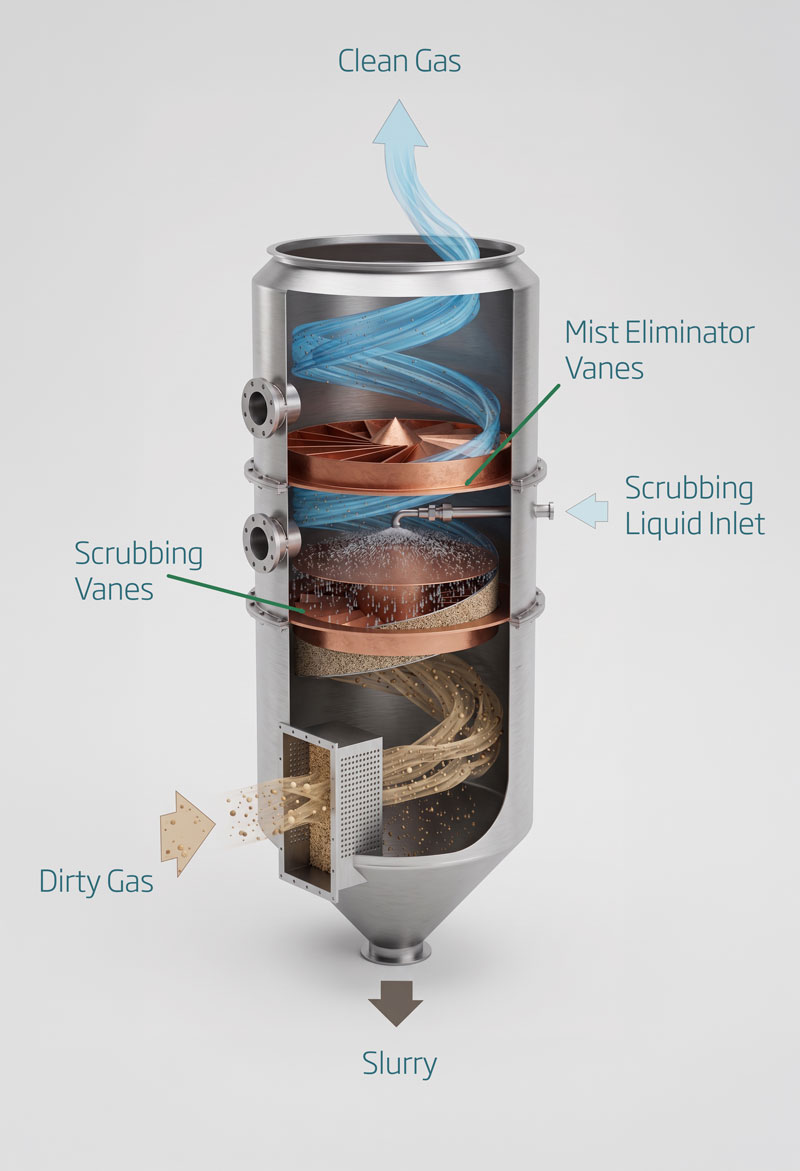
A wet scrubber is an air pollution control device that cleans an industrial gas stream by bringing it into contact with a scrubbing liquid, usually water. Particles collide with droplets, the droplets carry them out as slurry, and clean gas leaves through a mist eliminator. Some designs also absorb water-soluble gas-phase contaminants.
Start with measured data, not estimates. Inaccurate design data is the root of most overspending: a scrubber sized on bad numbers ends up with more fan horsepower or more scrubbing liquid than the process needs. Spending some money to gather the data will save you a lot of money throughout the life of the equipment.
Before you request a quote, collect:
A wet scrubber is one of three common options for industrial dust control. Compare it against a cyclone and a pulse jet filter (baghouse dust collector) before you commit.
| Cyclone | Pulse jet filter | Wet scrubber | |
|---|---|---|---|
| Airflow | Smaller airflows | Any airflow | Any airflow |
| Particle removal size | 5–10 µm | Submicron | Submicron |
| Maintenance | No moving parts | Yes | Minimum |
| Removes gaseous pollutants | No | No | Yes |
| Handles high-moisture gas | No | No | Yes |
| Needs explosion venting or containment | Yes | Yes | No |
| Pressure drop | 6–8 in. WC | 5–7 in. WC | Varies by design |
Source: MikroPul webinar, "Wet Scrubbers: Choosing the Right Solution."
A wet scrubber earns its place when your exhaust stream carries gaseous pollutants as well as dust, runs hot or wet, or carries combustible dust. It also suits processes that can take the slurry back. The trade-off is water: you will manage a slurry and a bleed stream that a cyclone or baghouse does not produce. Wet scrubbing is often preferred where dust is sticky or agglomerative where there is potential to foul filter media.
Wet scrubbers capture particles three ways:
Particles of about 3 µm and larger hit droplets because of their own mass.
Particles of about 1–3 µm follow the gas flow close enough to a droplet to touch it.
The finest particles drift into droplets through random motion.
The finer the particle, the more pressure drop you need to capture it, and pressure drop drives fan energy. Heavier particles (higher specific gravity) are easier to collect. A scrubber sized for submicron fume will waste energy on a coarse dust, and a low-energy scrubber will miss emission limits on fine fume.
Once you know your particles, three variables control both efficiency and operating cost:
More pressure drop captures finer particles and costs more fan power. On a venturi scrubber, an adjustable throat holds pressure drop constant as airflow changes, so you avoid running at a higher setting than needed.
L/G is the gallons of scrubbing liquid per 1,000 ACFM of gas. Raising it improves capture and adds pumping.
You can use more liquid rate or you can use a lower percentage of solid in the recycled loop to improve capture. Lower solids means discharging more water. Soluble particulates can tolerate a higher solids percentage, and dissolved and undissolved solids need different treatment.
With your data and targets set, match them to a scrubber design. The table below compares MikroPul's standard wet scrubber models by efficiency, pressure drop, liquid use and operating cost profile.
MikroPul builds five standard wet scrubber models plus a two-stage combination. The first four remove particulate; the packed tower removes gases.
| Model | Best fit | Efficiency | Pressure drop and L/G | Capacity (ACFM) | Operating cost profile |
|---|---|---|---|---|---|
| Mikro-Vane | De-dusting and drying; particles about 5 µm and larger; sugar and mining | About 90% at about 3 µm | 3–6 in.; L/G 2–4 | About 1,000–60,000 | Lowest. MikroPul's most economical model, with low liquid and energy needs. Ships in one piece |
| Dynamic Scrubber | Dust, aerosol and gas in metals and chemicals; spray drying, incineration, odor control | 99% at about 2 µm | About 5–6 in., performing like a 14–16 in. system; L/G 2–3 | 400–75,000 | Low energy and installation cost. Integral wetted fan removes separate blower ductwork; open paddle-wheel fan resists plugging |
| Venturi | Submicron to 3 µm; high inlet temperature, heavy loading, high solids recirculation; mining, food, metallurgy | 99%+ at 2 µm | Adjustable throat holds pressure drop constant as airflow varies | 400–300,000 | Higher fan energy for fine particles. Low maintenance: open-pipe liquid inlet instead of spray nozzles; wetted-wall inlet prevents build-up |
| Multi-Venturi | Large airflows and low-headroom sites | 99%+ at 2 µm | Lower pressure drop and L/G than a conventional venturi | 400–500,000 | Venturi-class efficiency at lower energy and liquid use. Two stages of mist elimination |
| Packed tower | Water-soluble gases: SO₂, HCl, HF, Cl₂, H₂S, HCN, NH₃; also gas cooling, humidification, condensing | High removal for soluble gases | Engineered per application | 500–75,000 | Skid-mounted with reagent preparation, fan, pumps and controls, which simplifies installation. Will not work on gases that do not dissolve in water |
| Multi-stage | Particulate and gas together, or acidic and basic gases in one tower | Venturi first stage plus packed tower second stage | Quench section for hot inlet gas; chimney tray keeps liquid loops separate | Per design | Handles two jobs in one footprint instead of two separate systems |
Figures from MikroPul webinar materials and the Five Standard Models video.
Most of a wet scrubber's operating cost traces back to choices made at the design stage. Pressure drop sets fan energy. The L/G ratio sets pumping and liquid volume. The percent solids you allow in the recycle loop sets how much water you discharge and replace.
| Cost driver | What sets it | How to keep it down |
|---|---|---|
| Fan energy | Pressure drop across the scrubber at your airflow | Specify the lowest pressure drop that meets your efficiency target, based on measured particle data |
| Scrubbing liquid and pumping | Liquid-to-gas (L/G) ratio | Choose a low-L/G design: Mikro-Vane runs at 2–4 and the Dynamic Scrubber at 2–3 |
| Water discharge and makeup | Percent solids allowed in the recycle loop | Run the highest solids level your efficiency target allows, and return the bleed stream to your process where you can |
| Maintenance | Spray nozzles, build-up, filter media, moving parts | Open-pipe liquid inlets, wetted-wall venturi inlets and designs with no filter media to replace |
| Installation and footprint | Separate ductwork between scrubber, blower and stack | An integral wetted fan, as in the Dynamic Scrubber, removes most of that ductwork |
| Explosion protection | Combustible dust in the gas stream | Wet scrubbers need no explosion venting, unlike cyclones and pulse jet filters |
These levers trade against each other. Raising the liquid rate or lowering percent solids improves capture, but more liquid means more pumping, and lower solids means more water to discharge. Higher pressure drop catches finer particles at the cost of fan horsepower. Good selection finds the balance point for your dust, your gas and your water situation.
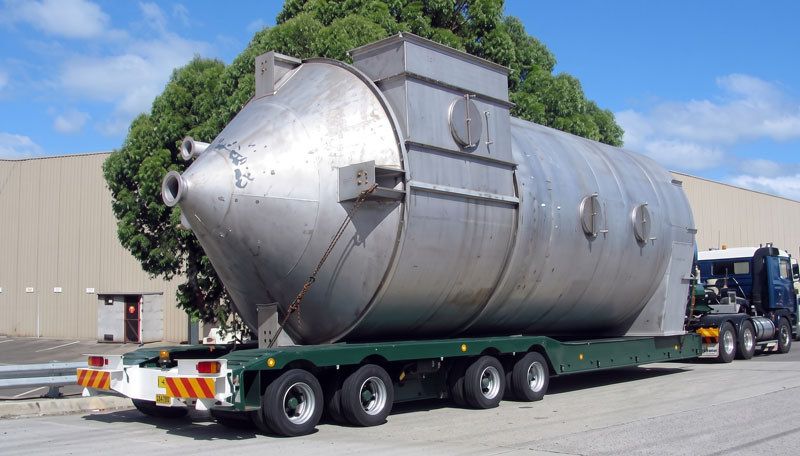
Coarse dust, budget-driven project
Fine particulate, tight floor space, or venturi-class efficiency at lower energy:
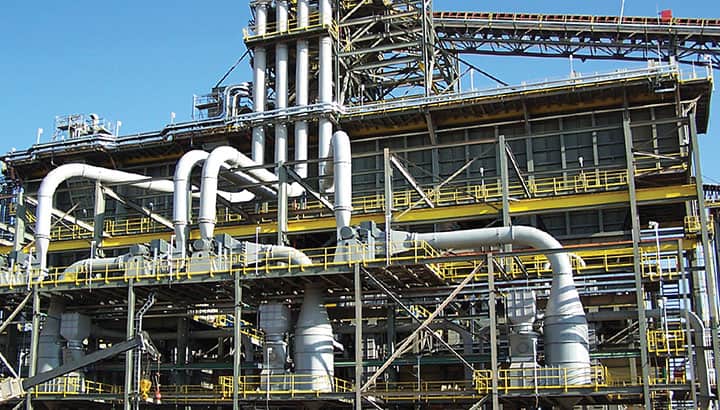
Hot gas, heavy dust loading or high solids recirculation, up to 300,000 ACFM
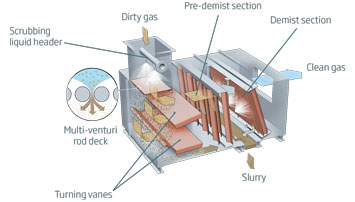
Very large airflow or limited headroom
Water-soluble gases
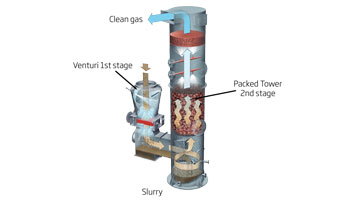
Particulate and gases from one source
Paper mills show how a lifetime-cost view can favor a wet scrubber even at a higher pressure drop. Paper manufacturers that handle explosive dust are moving to wet scrubbers. For their particle size distribution, the required pressure drop runs about 12–14 in.
That pressure drop costs fan energy, but the mills recover it elsewhere:
The biggest advantage is no explosion venting and in many applications they have used the bleed rate back into their system.
Instead of to disposal.
Which keeps maintenance cost low.
With a maintenance-friendly design proven in paper applications.
The lesson carries over to other industries. Compare the full operating picture, including explosion protection, media replacement and waste handling, not fan energy alone.
Three design variables set most of the operating cost: pressure drop, which drives fan energy; the liquid-to-gas ratio, which drives pumping and liquid volume; and percent solids in the recycle loop, which sets how much water you discharge. Maintenance, installation footprint and the need for explosion venting add to the total.
It depends on particle size. For coarse dust, the Mikro-Vane runs at 3–6 in. of pressure drop with an L/G of 2–4 and is MikroPul's most economical model. For finer particulate, the Dynamic Scrubber runs at about 5–6 in. and, according to MikroPul, performs like a 14–16 in. system.
Choose a wet scrubber when your gas stream also carries gaseous pollutants, runs hot or high in moisture, or contains combustible dust. Wet scrubbers remove submicron particles at any airflow and need no explosion venting. A pulse jet baghouse also captures submicron dust but cannot remove gases. A cyclone suits smaller airflows and particles of about 5–10 µm.
The liquid-to-gas (L/G) ratio is the volume of scrubbing liquid per volume of gas, usually stated in gallons per 1,000 ACFM. A higher L/G improves particle capture but increases pumping and liquid handling. MikroPul's Mikro-Vane runs at an L/G of 2–4 and the Dynamic Scrubber at 2–3.
Yes, most inorganics and some organics can be handled via wet-scrubbing. A packed tower scrubber removes pollutants such as SO₂, HCl, HF, Cl₂, H₂S, HCN and NH₃. A two-stage scrubber pairs a venturi with a packed tower to handle particulate and gases in one unit.
No. Wet scrubbers capture combustible dust in liquid, so they do not need the explosion venting or containment that cyclones and pulse jet filters require. Paper mills handling explosive dust use wet scrubbers for this reason, and many return the bleed stream to their process.
Connect with Nederman MikroPul to improve your dust collection.
Protecting People, Uptime, Performance with Nederman MikroPul. Thousands of Installations Worldwide